The animation below shows drawing a two-piece wooden cross from scratch in Easel. A long upright and a shorter crossbar are cut from quarter-inch wood, then glued face to face where they overlap. The wood is the design material; glue and a wall hanger are separate supplies.
Creating an Easel account is free. No credit card required.
Draw the upright as a 1 × 6-inch rectangle with an outside cut through the example ¼-inch stock.
Beside it, draw a 4 × 1-inch crossbar with the same through cut. The recording uses a 10 × 8-inch blank: the upright spans x=1 to 2 and y=1 to 7, and the crossbar spans x=3 to 7 and y=1 to 2. Both pieces fit inside the stock with space for the 1/16-inch cutter.
After cutting, remove the holding tabs and smooth the edges. Center the crossbar across the upright with its top 1½ inches below the upright’s top, then glue the 1 × 1-inch overlap. The joint is ½ inch thick; the rest remains ¼ inch thick. This makes a stepped cross rather than a flush half-lap joint.
Add a separate hanger suitable for the intended display. The recording supplies the simple cut pieces, not Celtic carving or floating-cross hardware, and does not establish physical joint strength.
Carve Celtic detail or suspend a cross inside an arch
Walnut carving keeps the cross in one piece; the red-oak design needs a frame and separate suspension hardware. The shared wooden geometry does not include the bandsaw work or magnets.
Debbie & Steve Lee carved the Celtic decoration into walnut, then cut the outside cross shape with a bandsaw. The shared file provides the carved pattern; do not expect it to supply the photographed outside cut. Their description identifies Easel Pro V-carving.
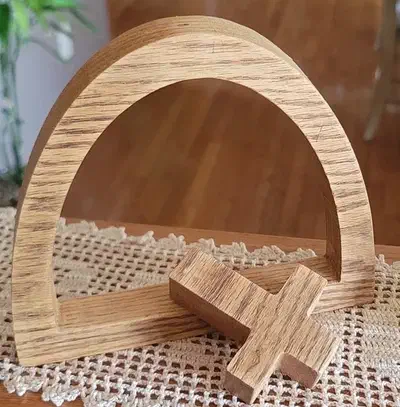
T. Brock’s red-oak design uses a cross suspended inside an arch. This photograph shows the complete arch and loose cross before suspension. The native workpiece contains three wooden shapes; two magnets and fishing line must be added to create the floating effect.
Creating an Easel account is free. No credit card required.
From Shannon Dolese’s project comment
Reveal the darker wood beneath the maple
Read the project comments without an account. Log in to post a question; replies are not guaranteed.
Cut just beyond the top layer
In his November 17, 2023 comment on Jesus_Cross_Layered, Shannon Dolese says he sets the top cut slightly deeper than the ⅛-inch maple layer to reveal the ¾-inch walnut beneath it.
The two-piece design needs a glued overlap; a carved one-piece cross needs its outer profile cut as well. Decide which construction you want before changing the proportions.

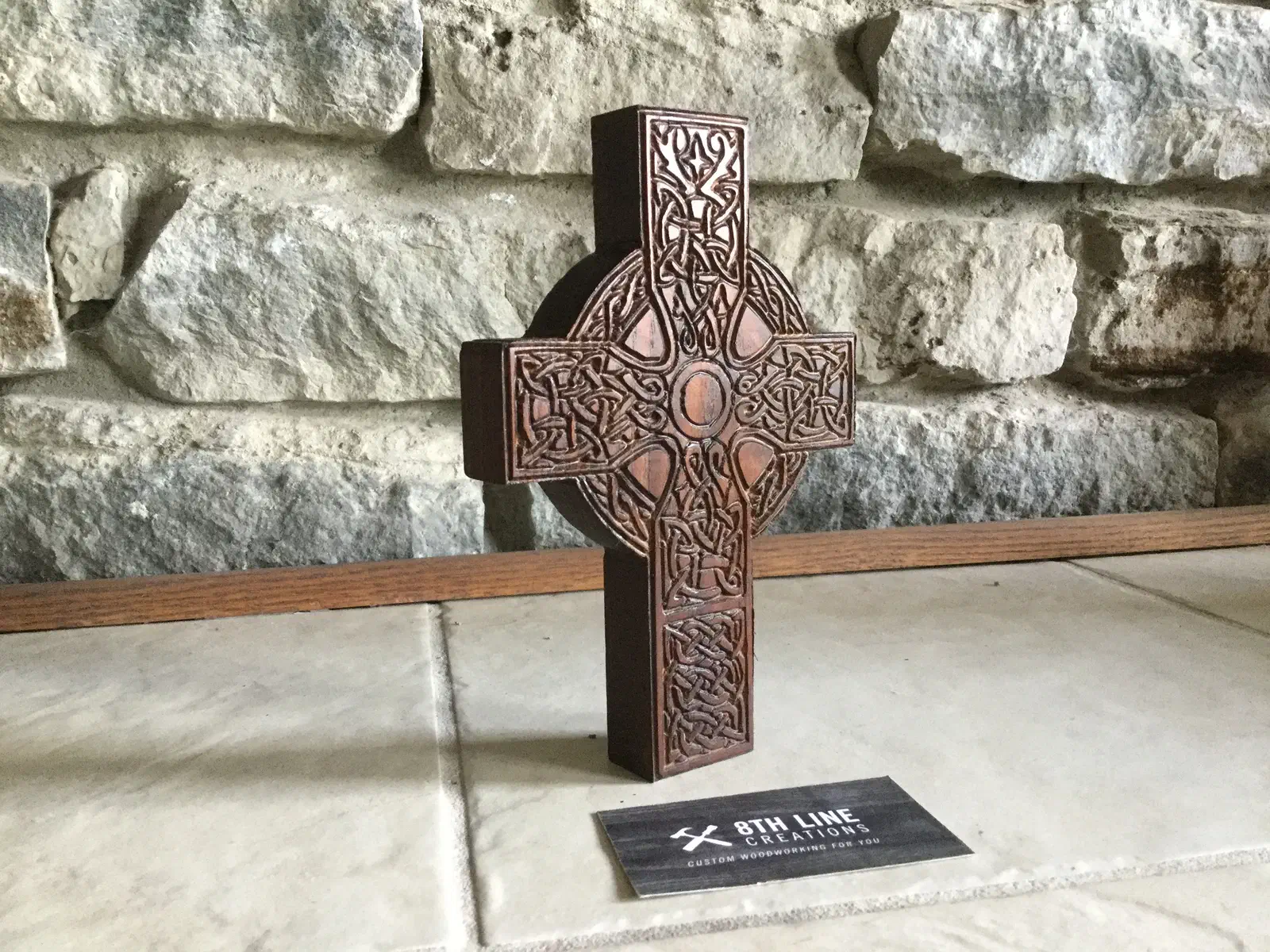 Celtic carving on walnutby Debbie & Steve Lee