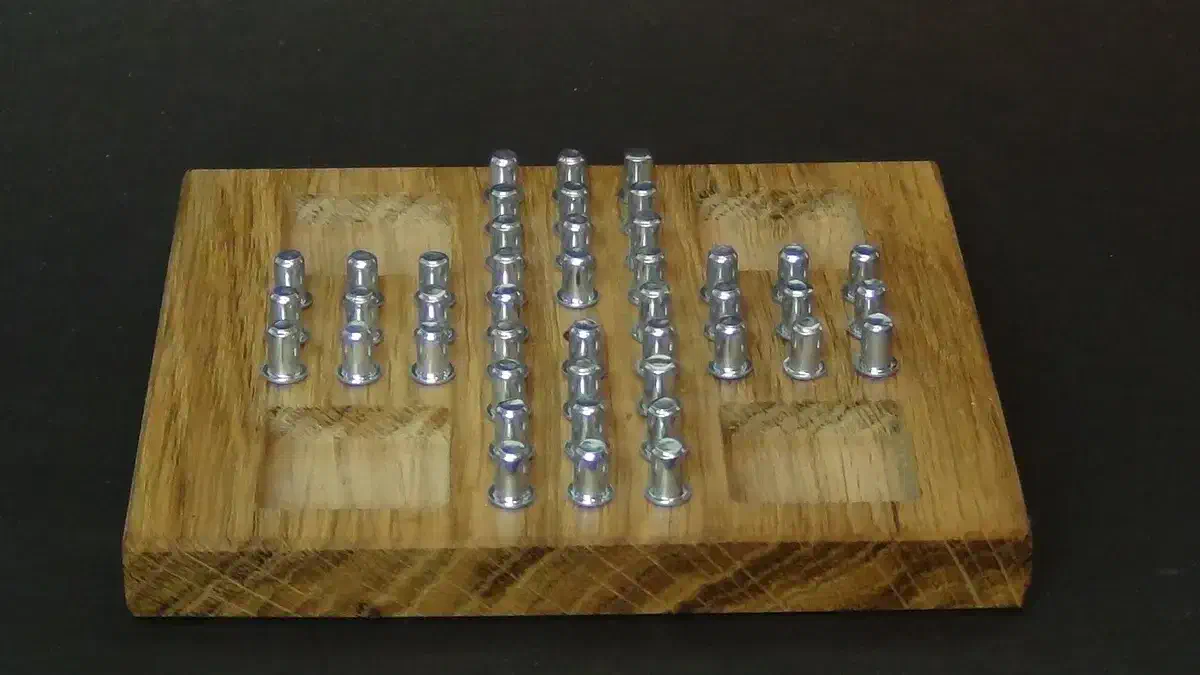
 English Solitaireby Mitch Peacock
English Solitaire
Mitch’s English Solitaire uses metal shelf-support pins in an oak board. His shared workpiece includes the playing pattern; his instructions finish the outer board shape separately with a saw.
Lay out a 33-hole peg-solitaire board in Easel and size the blind holes for the pins you want to play with.
Creating an Easel account is free. No credit card required.
Start from a blank workpiece
The animation below shows drawing a peg-solitaire board from scratch in Easel. Blind holes in the hardwood board seat the stems of separate metal shelf-support pins while their wider heads remain above the surface. Start with 32 pins and the center empty; jump a pin over its neighbor into an empty seat, then remove the jumped pin. For this untested design, assume 5 mm stems and heads no wider than 8 mm. Draw a 110 × 110 mm outside profile in 12.7 mm hardwood. Add 5.2 mm circles, 6 mm deep, on 12 mm centers in seven rows of 3, 3, 7, 7, 7, 3 and 3 seats. Keep the cross centered. Each seat leaves 6.7 mm of wood below it, with 0.2 mm total stem clearance and 4 mm between the reference pin heads. Remove the outside-cut holding tabs, smooth the board and fit-test the selected pins on scrap before assembly.
Creating an Easel account is free. No credit card required.
The pin stem determines the seat diameter, and its head determines the space between moves. Choose shelf-support pins or cribbage pegs, then size the playing pattern around that set.
English Solitaireby Mitch PeacockMitch’s English Solitaire uses metal shelf-support pins in an oak board. His shared workpiece includes the playing pattern; his instructions finish the outer board shape separately with a saw.
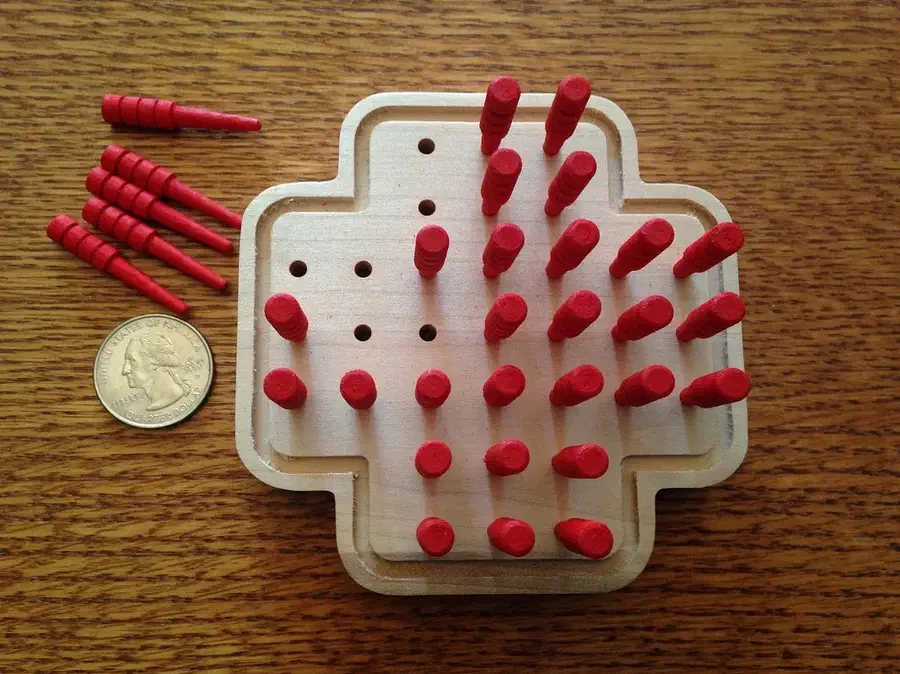 Peg Solitaire Gameby Gary Yahr
Gary uses red cribbage pegs in a shaped wooden board. Three workpieces supply the wooden layouts; add the separate game pegs and size their seats for the stems you choose.
See more solitaire search results →
Creating an Easel account is free. No credit card required.
Log in to post a question in the project discussion; replies are not guaranteed.
Mitch Peacock’s peg instructions call for 5 mm chromed shelf-support pins and a few spares. His setup step fills the game holes while leaving the central hole empty.
Project notes by Mitch Peacock: read the source.
From English Solitaire by Mitch Peacock.
Ask a questionCreate your free Easel account and connect your machine in minutes.
Creating an Easel account is free. No credit card required.