Make a dust-collection blast gate

Lay out a sliding blast gate in Easel with matching duct ports, a full-travel shutter and space for its handle and stops.

See the finished builds

Start from a blank workpiece

Design your own blast gate

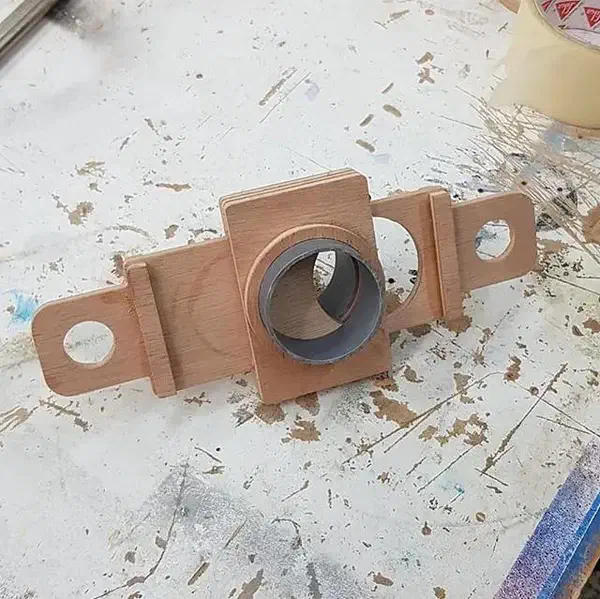
The animation below shows drawing a sliding dust-collection blast gate from scratch in Easel. Two plywood faces and two edge rails guide a thinner wooden shutter; separate PVC collars connect the duct, and two bolts through travel slots retain the shutter. Assume collars with 50 mm outside diameters, 6 mm plywood and 4 mm stop bolts. These are untested design dimensions, not measurements of purchased fittings or an airflow rating. Draw two 120 × 120 mm faces with centered 52 mm ports, two 9 × 120 mm rails and a 100 × 220 mm shutter. Pocket the shutter surface 0.5 mm deep, leaving 5.5 mm of plywood; add its 52 mm port centered 60 mm from one end. The rails form a 102 mm-wide, 6 mm-deep channel, giving the shutter 2 mm total side clearance and 0.5 mm thickness clearance. Add two 4.5 × 75 mm travel slots along the shutter edges and matching 4.5 mm bolt holes through the faces, outside the duct opening. A 4 mm bolt has 71 mm of center travel in a 75 mm slot; set the stop positions for 70 mm travel. That moves the shutter port 70 mm away from the face port, exceeding the 52 mm diameter by 18 mm so a solid section closes the duct. Assemble the faces around the rails with the shutter inside, keeping glue outside the sliding channel. Add the stop bolts, washers and locknuts with clearance to slide; epoxy the collars into the face ports. Remove profile tabs and test full open and closed travel, collar retention and leakage before connecting the gate to a dust collector.

Recorded in the Easel editor, playing at 4× real speed.

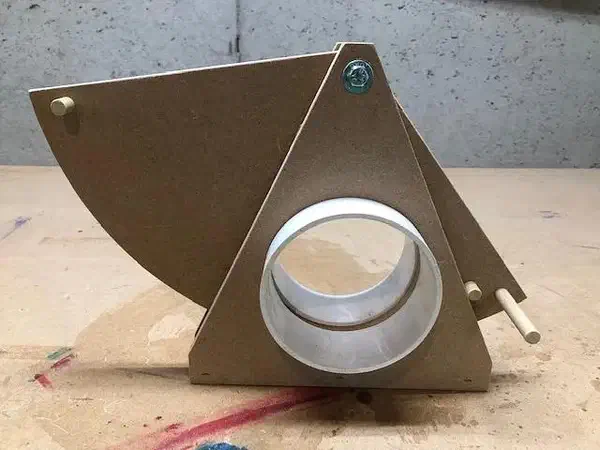
A pivoting 4-inch gate and a smaller sliding gate

A gate uncovers the duct when open and brings a solid shutter section across it when closed. Size the wooden ports around the collars selected for the duct.

See more blast gate search results →

Steve’s coupling-and-pipe adapter

Log in to post a question in the project discussion; replies are not guaranteed.

Steve’s coupling-and-pipe adapter

Steve Moloney cuts one sewer-and-drain coupling into two rings. He lines the coupling with a piece of 4-inch pipe to connect his standard dust-collector fittings.

Project notes by Steve Moloney: read the source.

From Steve's 4" Blast Gates by Steve Moloney.

Ask a question

Start creating with your CNC

Create your free Easel account and connect your machine in minutes.